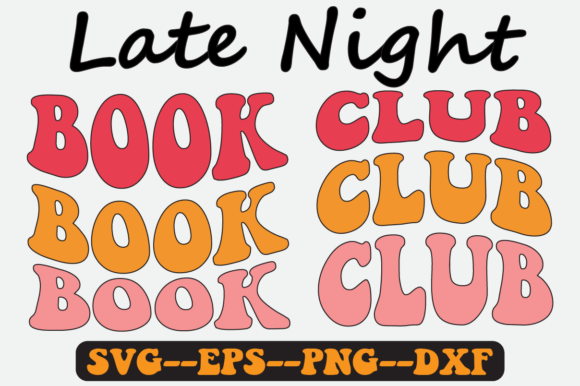
Late Night Book Club Groovy Retro SVG: Graphics for Crafts & Branding
As a brand designer and content marketer who’s built visual systems for indie publishers, bookish lifestyle brands, and creative entrepreneurs, I tested Late Night Book Club Groovy Retro SVG in a live campaign: launching a limited-edition “Midnight Pages” subscription box for literary-minded subscribers. Right away, the design landed with warmth and wit—no sterile vector stiffness, no overused clichés. It’s a graphic design asset that breathes personality: warm mustard yellows, soft burnt oranges, subtle halftone textures, and hand-drawn typography that leans into 70s book cover nostalgia without feeling kitschy or dated.
First Impression: Mood, Trust, and Audience Alignment
The Late Night Book Club Groovy Retro SVG doesn’t shout—it hums. It evokes cozy curiosity, quiet rebellion, and thoughtful escapism. That makes it ideal for audiences who value authenticity over polish: indie authors, small press publishers, online coaches teaching creative writing, bloggers covering slow living or bibliotherapy, and Etsy sellers of handmade journals or reading accessories. It signals “you’re welcome here—even if your highlighter is dried out and your tea’s gone cold.” That emotional tone builds audience trust faster than a generic serif font on a white background ever could.
Where It Strengthens Real Marketing Workflows
In our “Midnight Pages” campaign, we deployed Late Night Book Club Groovy Retro SVG across six touchpoints—and each time, it elevated clarity and consistency:
- Social media graphics: Used as a dynamic header for Instagram carousels and Pinterest pins—paired with clean sans-serif body text, it created instant visual hierarchy without competing for attention.
- Printable promotions: As a decorative border on downloadable reading challenge checklists and bookmark templates—its retro rhythm added tactile charm to digital downloads.
- Packaging accents: Printed on kraft paper inserts and sticker sheets inside subscription boxes—reinforcing brand identity without needing full-color printing.
- Email banners: Scaled cleanly for desktop and mobile previews; retained legibility even at 200px height thanks to bold line weight and intentional negative space.
- Canva templates: Imported as an editable SVG layer—allowed quick color swaps to match seasonal palettes (e.g., deep plum + sage for fall, terracotta + cream for spring).
- Digital product visuals: Featured on mockups for a Notion reading tracker template—gave the otherwise minimal UI a grounded, human-centered anchor.
Why It Builds Stronger Brand Recognition
This isn’t just clipart—it’s a commercial design with narrative cohesion. The recurring motifs (vintage microphone, open book with swirling smoke, retro “LATE NIGHT” banner) function like subtle brand signatures. When repeated across merch, email headers, and blog graphics, they create stronger first impression and better engagement. Unlike generic SVG bundles, Late Night Book Club Groovy Retro SVG feels curated—not assembled. That distinction matters for small business branding, where perceived effort equals perceived value.
Best Fit Use Cases (and Where to Pause)
Late Night Book Club Groovy Retro SVG shines brightest in:
- Hero graphics for literary newsletters or podcast show notes
- Campaign headers for book launches, reading challenges, or author spotlights
- Branded templates for Canva, Google Slides, or Notion used by content creators
- Packaging accents on eco-friendly mailers or gift wrap
- Decorative brand elements on website footers, blog sidebars, or digital lead magnets
Use carefully in:
- Formal corporate branding (e.g., law firms or financial advisors—tone mismatch)
- Dense information layouts (e.g., comparison tables or pricing grids—distraction risk)
- Small mobile graphics under 120px wide (fine details like halftones may blur)
- Low-contrast backgrounds (e.g., light gray on off-white—test contrast ratios)
- Brands committed to ultra-minimal aesthetics (it’s intentionally expressive, not restrained)
Practical Brand Designer Notes You’ll Actually Use
Before dropping Late Night Book Club Groovy Retro SVG into production, run these checks:
- Test it with your brand color palette: Swap its base colors using vector editing tools—does it still feel cohesive next to your primary and secondary hues?
- Check black-and-white usage: Print a grayscale version—does the silhouette hold? Does texture translate as tone rather than noise?
- Place it inside real campaign mockups: Drop it into a Shopify product page header or Instagram Story frame—does it guide the eye or scatter it?
- Preview on mobile screens: Zoom to 50%—is the “BOOK CLUB” text still legible? Are key shapes distinct?
- Compare against competitor visuals: Does it stand out in a feed of similar lifestyle brands—or fade into retro fatigue?
- Pair it with fonts: Try it beside serif (e.g., Playfair Display), sans-serif (e.g., Inter), script (e.g., Pacifico), and display fonts (e.g., Bungee)—which combo feels most authentic to your voice?
- Review spacing and balance: Does it leave breathing room around headlines and CTAs—or crowd critical content?
- Confirm commercial licensing: Verify usage rights for paid ads, client deliverables, and resale items like printed mugs or hoodies—this is a digital product with real legal boundaries.
A Strategic Asset—Not Just Decoration
Late Night Book Club Groovy Retro SVG works because it’s both specific and adaptable. It speaks clearly to a niche—readers, thinkers, night owls—but doesn’t lock you into one rigid application. As a printable design, it supports physical products like mugs and onesies. As an SVG design, it scales flawlessly for web and social. As part of a design bundle, it adds tonal depth to broader creative marketplaces. Most importantly, it helps content creators avoid the “generic design trap”—where every visual looks interchangeable and forgettable. In a crowded feed or cluttered inbox, this kind of creative design doesn’t just decorate. It declares: This is who we are. This is who we’re speaking to. And yes—we’ve thought about how it feels to be on the other side of the screen.