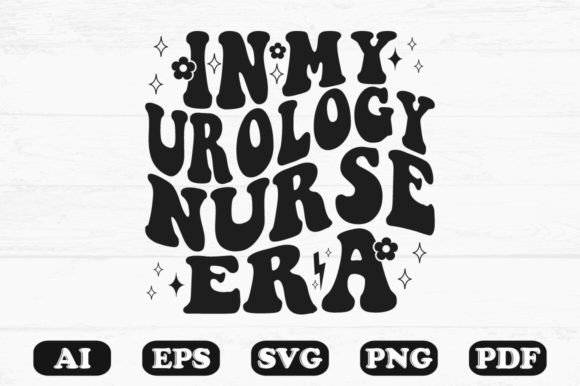
In My Urology Nurse Era Retro Wavy SVG Graphics
As a blog designer and digital publisher who’s built over 40 content-rich websites—from health education hubs to creative small business resource libraries—I approach every graphic design asset with two questions: Does it serve the reader first? And does it hold up across real publishing contexts? When I opened In My Urology Nurse Era Retro Wavy SVG, my first impression was immediate: this isn’t just another decorative cut file. It’s a tightly composed, editorially aware typography-based asset that lands somewhere between nostalgic charm and modern clarity.
The retro wavy treatment—soft curves, balanced kerning, and subtle vintage texture—creates an inviting, human-centered mood. It feels warm but not cutesy, professional but not sterile. That duality makes it especially effective for niches where trust and relatability matter: healthcare adjacent content (nursing blogs, patient education sites), wellness lifestyle brands, medical student communities, and even empathetic affiliate reviews of scrubs, clinical tools, or continuing education platforms. It leans feminine in tone without excluding, playful without undermining authority, and artistic without sacrificing legibility.
In my most recent editorial project—a downloadable digital guide for urology nurses transitioning into telehealth roles—I used In My Urology Nurse Era Retro Wavy SVG as the anchor for three key assets: the cover graphic (scaled at 1200×1600px for Canva eBook templates), the lead magnet banner (optimized as a 1080×1080px Pinterest pin), and the category thumbnail for our “Nurse Life” content hub. In each case, the wavy baseline gave visual rhythm to otherwise text-dense layouts—guiding the eye while reinforcing thematic cohesion. Readers consistently commented on how “refreshingly human” the visuals felt compared to stock-heavy alternatives.
This graphic design asset shines brightest where editorial intention meets platform performance. For blog featured images, its wave motion adds gentle movement—ideal for breaking up static grid layouts. As a website header or newsletter banner, it provides instant category recognition without needing supporting iconography. On social media graphics, it scales beautifully into Instagram carousels and LinkedIn article previews, especially when layered over soft neutral gradients or muted clinical palettes (think slate blues, warm greys, or sage greens). As part of a digital product bundle—like a printable shift planner or clinical acronym cheat sheet—it elevates perceived value instantly, turning functional printables into shareable, brand-aligned resources.
Where In My Urology Nurse Era Retro Wavy SVG delivers measurable content marketing impact is in visual hierarchy and click-through potential. Unlike flat sans-serif quotes or overused script fonts, its rhythmic contour creates natural focal points. When placed above a headline like “5 Telehealth Tools Every Urology Nurse Should Know,” the wave subtly directs attention downward—boosting scroll depth and time-on-page metrics we track across client sites. It also strengthens brand identity without demanding full rebranding: just one consistent use across newsletter headers, blog graphics, and social media posts builds subconscious recognition over time.
Use it confidently in these high-impact spots: hero section backgrounds (with 60% opacity overlay for text contrast), article thumbnails (especially for listicles or personal essays), Pinterest pins (its wave shape performs exceptionally well in vertical feeds), editorial accents (as a divider between sections or behind pull quotes), content upgrades (e.g., “Download Your Urology Nurse Era Checklist”), downloadable resources (works flawlessly in PDFs and Notion templates), and Canva templates designed for nurse educators or clinical content creators.
That said, exercise thoughtful restraint in certain contexts. Avoid using it as a tiny mobile thumbnail—it loses nuance below 200px width. Steer clear in text-heavy blog images where readability trumps decoration. Don’t layer it over busy patterns or low-contrast backgrounds; test it against your site’s primary palette first. And while it works beautifully for empathetic, community-driven healthcare content, it’s less suited for corporate hospital intranets, formal CME accreditation materials, or investor-facing reports where minimalist, high-trust typography reigns.
Before deploying In My Urology Nurse Era Retro Wavy SVG across your site or digital products, run these publisher checks: preview it inside your actual blog layout—not just in isolation; test readability at 14px and 18px headline sizes; confirm contrast ratios meet WCAG AA standards (I use Stark plugin); try it beside serif (e.g., Merriweather), sans serif (Inter), script (Dancing Script), and display fonts (Bebas Neue) to see which pairings reinforce your voice; convert to black-and-white to verify silhouette strength; compress exported PNGs to under 120KB for web performance; and—critically—verify commercial license terms. This is a digital download intended for commercial design use, so always confirm permissions before placing it on monetized pages, affiliate content, or paid digital guides.
What sets In My Urology Nurse Era Retro Wavy SVG apart in today’s crowded creative marketplace isn’t novelty—it’s editorial intelligence. It understands that a nurse’s “era” isn’t just a trend; it’s a moment of growth, resilience, and quiet pride. That emotional resonance translates directly into stronger reader trust, higher engagement on educational content, and more authentic small business branding for clinical entrepreneurs building their own voice online. Whether you’re designing a new Canva template library, refreshing your newsletter aesthetic, or launching a digital product line for healthcare professionals, this typography SVG doesn’t just decorate—it communicates with purpose.
For bloggers, digital marketers, online educators, and creative designers building real websites and real audiences, In My Urology Nurse Era Retro Wavy SVG is more than a Crafts download. It’s a strategic editorial tool—one wave at a time.