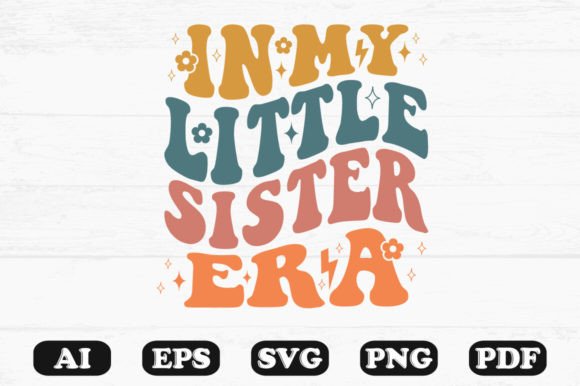
In My Little Sister Era Retro Wavy SVG
A Designer’s First Look: Nostalgia with a Soft, Wavy Edge
When I opened In My Little Sister Era Retro Wavy SVG, my first thought wasn’t “cute” — it was “worn-in.” That gentle, hand-drawn wobble in the letterforms feels like something pulled from a 90s bedroom wall or a well-loved zine. It’s not aggressively retro; it’s quietly affectionate. The layout leans into asymmetry and subtle rhythm — no rigid baselines, no forced symmetry — which gives it breathing room on fabric. As a designer who regularly translates digital files into machine embroidery designs, I immediately asked: *Will this hold up when stitched? Does it have enough weight to read clearly at 3–4 inches tall? And most importantly — does it feel handmade, even before the needle touches cloth?*
Real Project Test: Embroidering a Linen Tote for a Local Boutique
Last week, I used In My Little Sister Era Retro Wavy SVG to embroider a set of linen tote bags for a small-town gift shop. The client wanted something warm, personal, and slightly nostalgic — not trendy, not ironic. We chose soft oat-colored linen (medium weight, tight weave) and paired it with muted sage and dusty rose thread. The result? A design that landed exactly where it needed to: tender but confident, vintage without costume, legible without shouting.
The wavy baseline translated beautifully into satin stitch outlines — the curves gave the lettering movement and charm, while the spacing between letters prevented fill-stitch bleed on the textured surface. No crowding. No lost details. Customers kept commenting on how “soft” the embroidery felt — not just in thread choice, but in the design’s inherent gentleness.
Where This Design Shines (and Where It Needs Care)
In My Little Sister Era Retro Wavy SVG is strongest on stable, medium-to-heavy fabrics: canvas totes, cotton sweatshirts, denim jackets, tea towels, and pillow covers. Its relaxed proportions and open letterforms give it natural grace on curved surfaces like caps — as long as you keep the hoop size generous (at least 4×4 inches) and use cutaway stabilizer to support those delicate wave peaks.
Use caution on:
- Thin or stretchy fabrics — like lightweight jersey or ribbed knits — where the wavy lines may distort under tension or shift during hooping;
- Dark or heavily textured backgrounds — fine inner curves can get visually swallowed unless thread contrast is high and stitch density is carefully balanced;
- Baby onesies or tiny garments — scaling below 2.5 inches risks losing the nuance of the wave; the charm lives in its gentle amplitude;
- Patches or layered appliqué — this isn’t a bold outline-first design; it reads best as direct embroidery, not a cut-and-sew shape.
What It Adds to Your Finished Product
This isn’t just text. It’s tone. When stitched cleanly, In My Little Sister Era Retro Wavy SVG elevates a simple tote or sweatshirt into something emotionally resonant — the kind of piece people pause over, smile at, and ask, “Where did you get this?” That quiet storytelling builds trust. For Etsy sellers and craft business owners, that means higher perceived value, better photo engagement, and repeat customers drawn to authenticity over algorithm-chasing trends.
It also supports brand consistency beautifully. Whether you’re building a line of nursery decor, holiday embroidery kits, or personalized gifts for sisters and cousins, this design carries warmth without leaning into cliché. It doesn’t scream “gift,” but it whispers “thoughtful.” That subtlety makes it versatile across seasons and occasions — equally at home on a spring baby blanket or a cozy fall sweatshirt.
Practical Embroidery Designer Notes
Before stitching your first In My Little Sister Era Retro Wavy SVG project:
- Test on scrap fabric first — especially if using textured or dark materials. Watch how the waves behave at your target size;
- Check thread color contrast — this design relies on clarity of form, not heavy saturation. A low-contrast combo (e.g., light gray on heather grey) can mute its charm;
- Review stitch density — avoid overloading small curves with dense fill; let running stitch or lighter satin work do the lifting;
- Confirm hoop size and stabilizer match — wavy lines need stability, not rigidity. Cutaway works best for apparel; tear-away suffices for stable woven goods like tea towels;
- Inspect small details — zoom in on corners and wave peaks in your embroidery software. If they look pinched or jagged digitally, they’ll stitch poorly;
- Test black-and-white mockups — this design’s strength is tonal balance, not color pop. See how it reads without hue as a crutch;
- Verify licensing — since this is a digital embroidery file sold as part of an SVG bundle, confirm whether commercial use (e.g., selling finished embroidered totes or digital product previews) is permitted by the original creator.
Final Thought: A Quietly Confident Choice
In My Little Sister Era Retro Wavy SVG won’t dominate a tradeshow booth or trend-jack social feeds. But it will make someone pause mid-scroll. It will land softly on a baby blanket and stay meaningful after ten washes. It will help a small shop owner build a cohesive, heartfelt collection — not just a catalog of designs. As a crafts professional, I reach for it when I want sincerity over spectacle, when the goal isn’t to be seen first — but remembered longest. That’s the mark of a truly useful embroidery file: it serves the person wearing it, not just the maker stitching it.