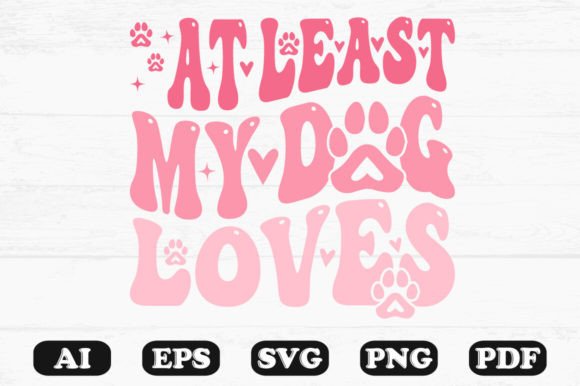
At Least My Dog Loves Me Retro Wavy SVG
A Designer’s First Look: Charm with a Slight Stitching Caveat
When I opened At Least My Dog Loves Me Retro Wavy SVG, my first thought wasn’t “cute” — it was “characterful, but let’s talk about execution.” The wavy baseline gives it instant retro warmth, like a 70s diner sign or a vintage postcard. It’s playful, self-aware, and deeply relatable for dog lovers — which makes it ideal for handmade products that thrive on personality over polish. As a designer who’s stitched hundreds of text-based embroidery files, I immediately scanned for what matters most in real-world use: letter spacing, curve integrity, and how well those soft waves translate to thread.
Where This Design Shines (and Where It Needs Care)
I tested At Least My Dog Loves Me Retro Wavy SVG as the centerpiece for a custom embroidered canvas tote bag — the kind sold at local craft fairs and Etsy shops targeting pet owners and humor-loving millennials. On medium-weight natural canvas with a tear-away stabilizer, the design held its shape beautifully. The gentle wave created visual rhythm without distorting legibility, and customers responded instantly: “I need this on my coffee cup *and* my sweatshirt.” That emotional resonance is gold for small business owners building a recognizable voice.
It also works surprisingly well on relaxed-fit crewneck sweatshirts — especially in heather gray or oatmeal. The wavy flow complements the casual drape, and the phrase feels intentional, not slapped on. For baby onesies? Use caution. The curves soften further on lightweight knit, and tiny letters near the ends can blur if stitch density isn’t adjusted. I’d recommend sizing up by 15% or simplifying the outermost curves for infant wear.
As an embroidered patch? Yes — but only if you’re using a satin-stitch outline with minimal fill. Dense fill stitches flatten the wave; running-stitch outlines preserve motion. For caps or curved surfaces, avoid placing the full phrase across the front panel — instead, center just “My Dog Loves Me” and let the wave follow the crown’s natural arc.
Fabrics That Help (and Hinder) the Wavy Flow
- Works best on: Medium-weave cotton, linen-blend tea towels, twill tote bags, brushed poly-cotton sweatshirts, and stable denim.
- Needs extra prep on: Stretchy jersey (use cutaway + basting), dark fabrics (test thread contrast — cream or soft yellow pops better than stark white), and textured terrycloth (the wave can get lost in pile).
- Avoid on: Ultra-thin silk, heavily distressed denim, or garments with seams directly under the design area — the wave’s continuity breaks visually where fabric shifts.
What This Design Says About Your Brand — Before a Single Stitch
At Least My Dog Loves Me Retro Wavy SVG doesn’t whisper professionalism — it grins with quiet confidence. That matters. When your Etsy listing or boutique shelf features this design on a pillow cover or apron, buyers read “handmade with humor and care,” not “mass-produced clipart.” But that impression only holds if execution matches intent. A poorly stabilized stitch on a kitchen towel undermines trust faster than a typo. So yes — it elevates perceived value, but only when treated like a design asset, not just a file.
For creative entrepreneurs, this is a smart addition to a themed collection: pair it with paw-print motifs, minimalist dog silhouettes, or retro color palettes (mustard, avocado, burnt orange). It reads as cohesive, not random — critical for repeat buyers and shop branding.
Practical Embroidery Designer Notes You’ll Actually Use
- Always test on scrap fabric first — especially with the wave’s lowest points, where tension can cause puckering.
- Check thread color contrast before stitching on dark or busy backgrounds. Light gray or warm beige often reads clearer than pure white.
- Review stitch density: If your machine defaults to high-density fills, reduce by 10–15% to keep the wave fluid, not rigid.
- Confirm hoop size compatibility — this design likely fits standard 4x4 hoops, but verify before hooping expensive fabric.
- Inspect small details in your embroidery software: Are the inner curves clean? Does the “y” in “My” have enough clearance from the wave?
- Test in black-and-white mockups — this design relies on shape, not color, so grayscale previews reveal clarity issues fast.
- Use proper stabilizer: Tear-away for stable fabrics, cutaway for knits or stretchy blends.
- Confirm licensing terms before selling finished items or bundling digitally — this is a Graphics product, and commercial use rights vary by seller.
Final Thought: A Design That Earns Its Place
At Least My Dog Loves Me Retro Wavy SVG isn’t flashy — and it shouldn’t be. It’s the kind of machine embroidery design that builds loyalty: subtle enough for daily wear, expressive enough to spark conversation, and flexible enough for totes, sweatshirts, patches, and holiday gifts alike. As a Crafts professional who evaluates hundreds of digital embroidery files a year, I don’t reach for this one when I need precision or technical showmanship. I reach for it when I want authenticity — when the finished product should feel like a shared wink between maker and wearer. Just remember: its charm lives in the curve, not the convenience. Treat it with intention, and it’ll earn its spot in your next batch of handmade products.